The Dangers of Unlined Wood Inserts
It’s been a common practice by homeowners in the past (20–40 years ago) to simply place an insert inside of an existing open-burning fireplace. The gap between the insert and the original fireplace opening would then be covered by decorative trim and sometimes stuffed with insulation to prevent cold drafts or smoke backdrafts. Unfortunately, despite a higher heat output (versus an open-burning fireplace), this kind of installation method produces more problems and a higher probability of a chimney fire. Here’s why:
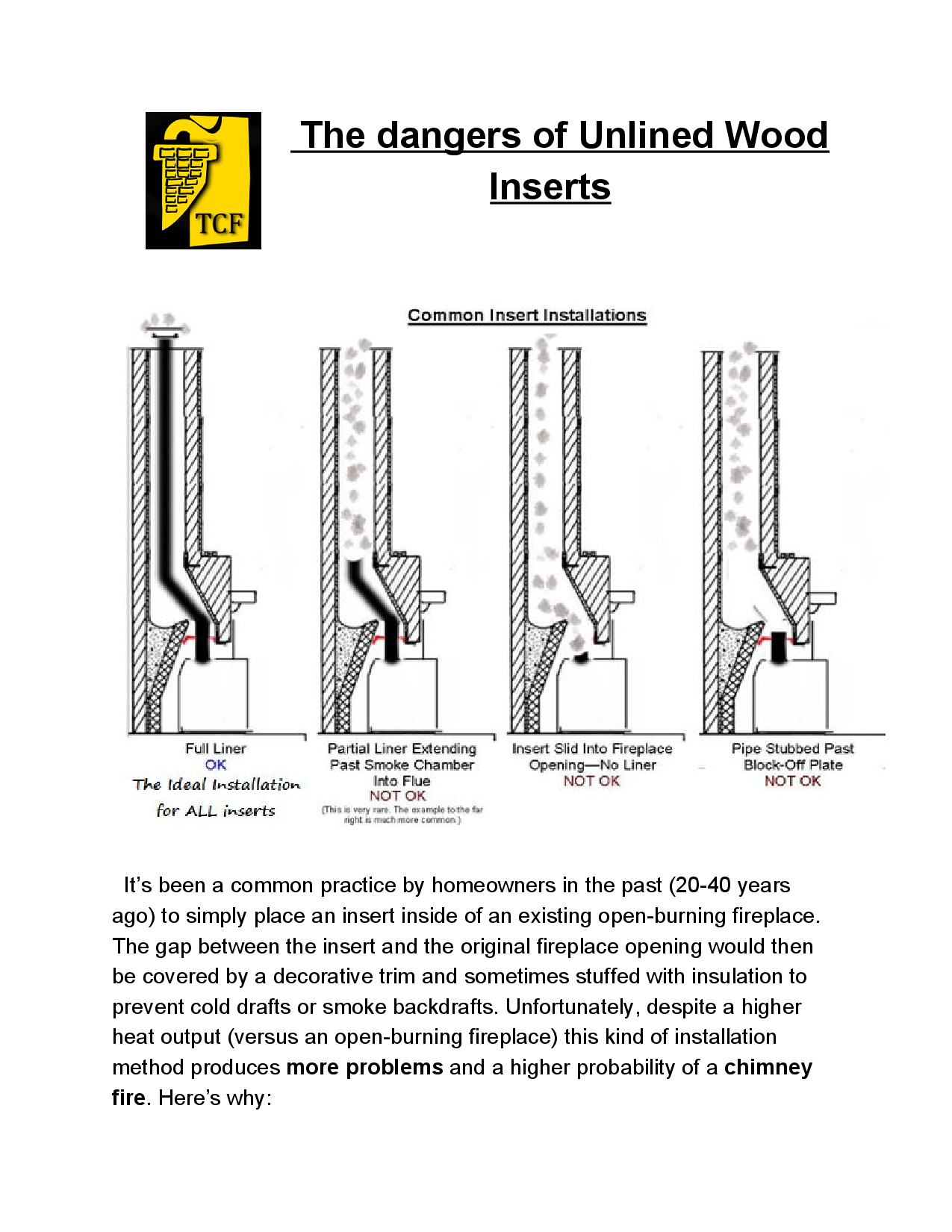
Common insert installations — only a full liner is correct.
1More Frequent Chimney Fires
The insert or stove itself was designed to produce smoke volume to maintain an optimal draft in a chimney sized to the diameter dictated by the insert top collar. The top collar is usually 6–8 inches, which translates to 28–50 sq. in. of cross-sectional area of the flue.
Without a 6”–8” stainless steel liner installed from the insert to the top of the chimney, the insert introduces the smoke to a much larger passage. First the smoke enters the fireplace chamber itself, it billows for a while and then transfers to the smoke chamber (above the damper area). After that area is full, it finally pushes into the actual clay flue tile chimney, which is usually 8”x13” to 13”x17” in size. That translates to 104–221 sq. in. of cross-sectional area.
You can see how the smoke has to travel through an area about 4 times larger than it was designed for, which is also many times more surface for creosote to adhere to. It is as if the chimney was 4 times longer. This results in extended residence time (smoke slows down) and more time for the unburned carbon molecules to cool down, connect to droplets of water vapor and deposit on the walls of the chimney as creosote.
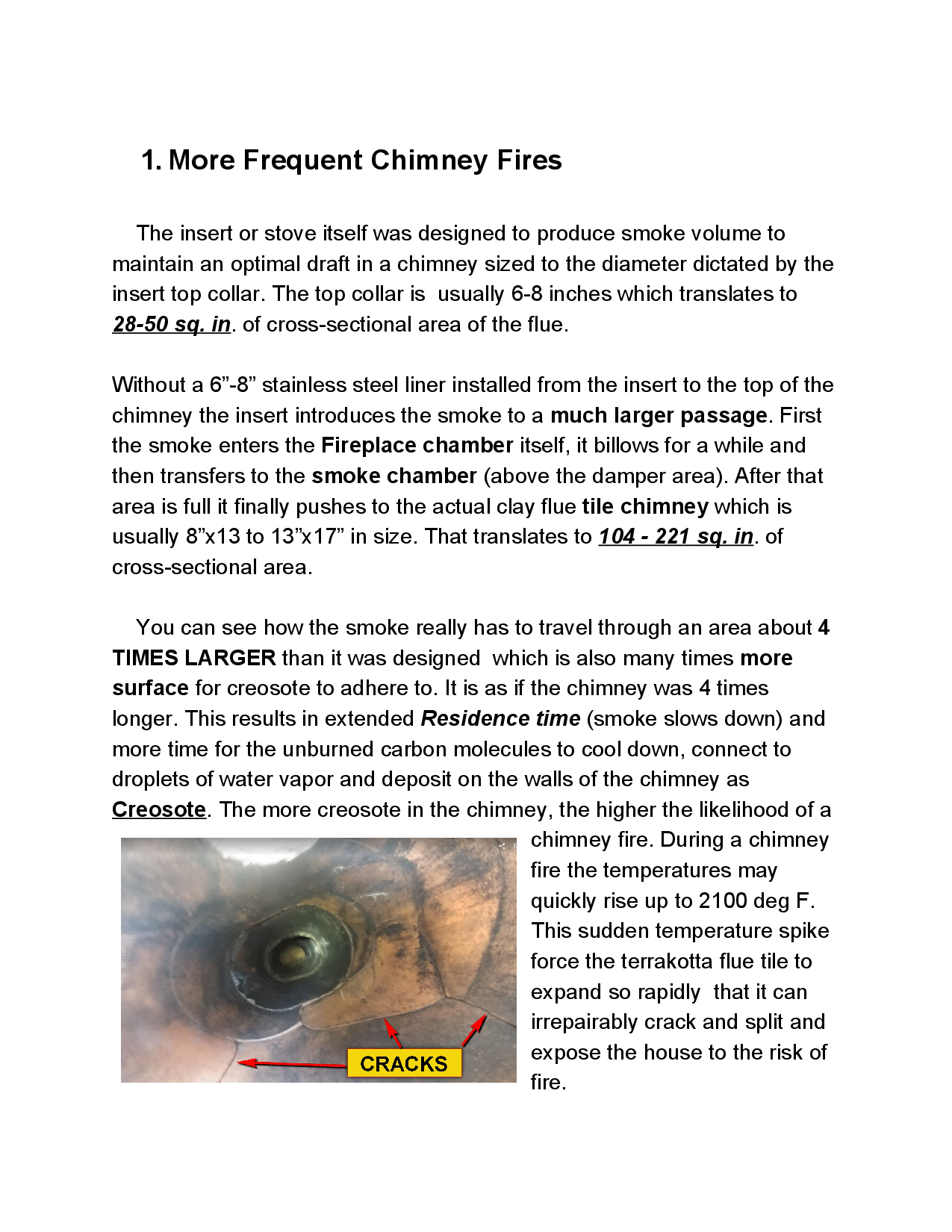
The more creosote in the chimney, the higher the likelihood of a chimney fire. During a chimney fire the temperature may quickly rise to 2100°F. This sudden temperature spike forces the terracotta flue tile to expand so rapidly that it can irreparably crack and split, exposing the house to the risk of fire.
2Improper Cleaning
The process of cleaning an unlined system is very labor intensive. It requires removal of the trim, removal of the insert, cleaning of the firebox, smoke chamber and chimney, and then re-installation of the insert. This can add up to 3 or more hours and double the cost.
As a result, unscrupulous chimney sweeps sometimes clean the chimney without removing the insert, and a massive amount of creosote piles right on top of the insert, waiting there like a time bomb to ignite and set off a chimney fire.
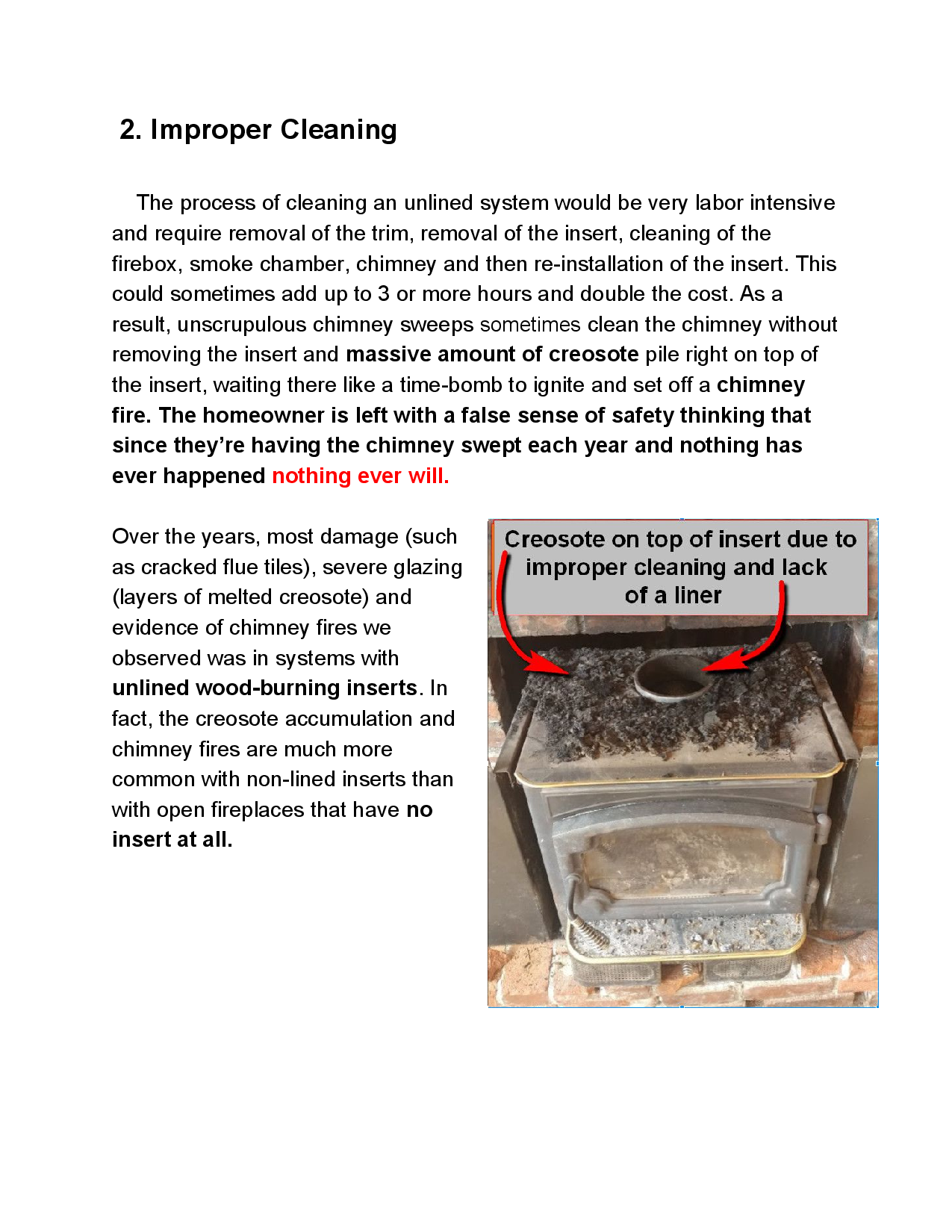
The homeowner is left with a false sense of safety, thinking that since they’re having the chimney swept each year and nothing has ever happened, nothing ever will.
Over the years, most damage (such as cracked flue tiles), severe glazing (layers of melted creosote) and evidence of chimney fires we observed was in systems with unlined wood-burning inserts. In fact, creosote accumulation and chimney fires are much more common with non-lined inserts than with open fireplaces that have no insert at all.
The Solution
Installation of a properly sized and insulated liner costs about $1,500 to $2,000. However, if your insert (as in most cases) is an outdated, low-efficiency, non-EPA-certified unit, it would not be legal or practical to connect a liner to it:
- The Tahoe Regional Planning Agency (TRPA) prohibits installation of units that have not been certified by the EPA.
- Because of the incomplete combustion of non-EPA units, connecting one to a liner may actually damage it or create cycles of premature clogging and dramatically shorten the life of such an investment.
For best results, a full reline connected to an EPA-certified appliance is not only the solution but also a positive upgrade in terms of:
- Safety (completely sealed firebox)
- High efficiency
- Ease of use
- Wood consumption (less wood and less reloading)
- Ambiance (ceramic glass doors on all units)
- Heat distribution (built-in blowers)
- Less pollution (approx. 5 grams/h instead of 50+ grams/h)
Tahoe Chimney & Fireplace offers a wide range of solutions including wood, gas and pellet inserts. For pricing visit tahoestoves.com.
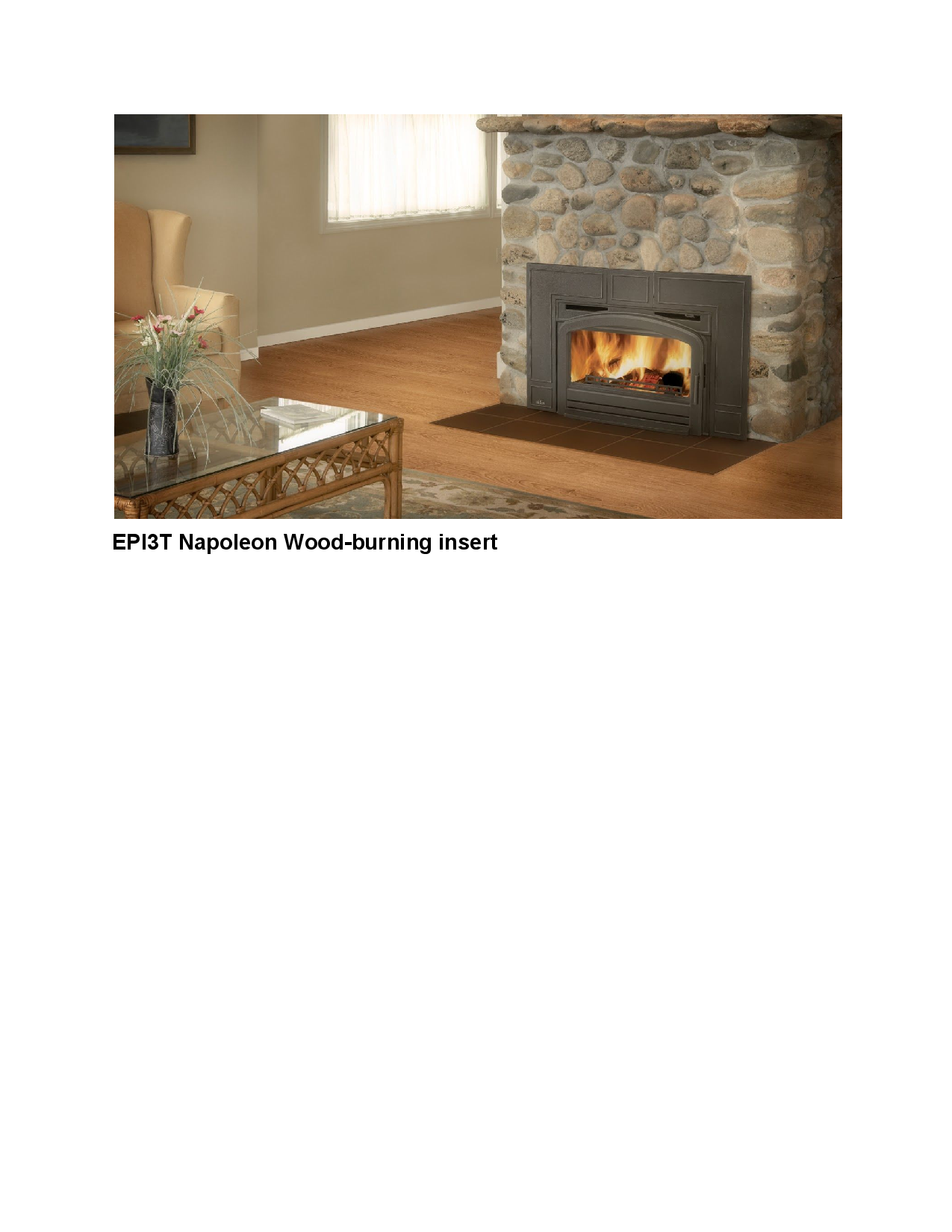
EPI3T Napoleon wood-burning insert
