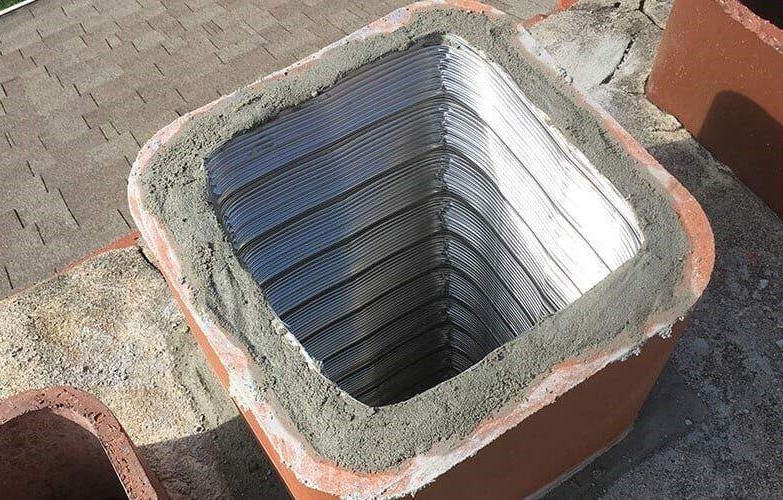
Chimney Relining is needed when:
- The current clay tile liner is damaged by AGING, CHIMNEY FIRES, MOISTURE AND EARTHQUAKE.
- The liner is missing (such as in older homes with brick chimneys)
- A new high efficiency stove or insert is being installed
What is a liner for?
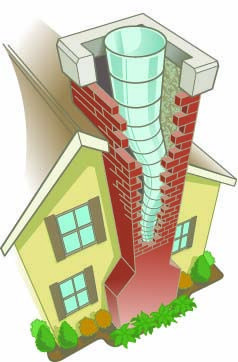
Liners contain the smoke and make sure it safely exits the home structure. If missing or damaged, smoke and creosote may accumulate beyond the intended passage. House fire may happen as soon as sparks or heat affect the combustible structures around the
chimney, however very often the creosote accumulation in the wrong place may take months or even years giving a false sense of “everything is fine” before a house fire occurs.
How do I know if I need a liner?
If your house is 40 years or older, there is a good chance you need one, but usually such determination comes after your chimney is inspected by a professional.
What Kind of Liners do we use?
Tahoe Chimney & Fireplace uses only high quality insulated stainless steel liners, 304 and 316 alloys. These liners are either flexible or come in rigid sections. A liner installed by us is ALWAYS insulated to meet UL1777 standard. The extra insulation ensures
that the gases passing through the chimney do not cool down prematurely and cause excessive creosote build-up.
How a liner is installed in a masonry fireplace
Every relining job is different, and the biggest factor is the firebox itself. The new liner has to connect to the top of the smoke chamber, the area just above the fireplace opening, and the way we get to that spot depends on what your fireplace is built from.
Brick firebox
With a brick firebox, we work from inside the fireplace. We carefully break out the slanted back wall above the damper, over the smoke shelf, so we can reach the top of the smoke chamber. From there we connect the bottom of the liner to the smoke chamber with the proper adapters, then rebuild the back wall with new firebrick. It is a multi-day job, but the work stays in the fireplace.
Steel firebox
A steel firebox cannot be cut open and welded back together without compromising its integrity, so we leave it alone and reach the smoke chamber from the masonry around it instead. We make an access opening at the back or the front of the fireplace, whichever is easier and least disruptive for your home. We then make the connection to the liner and rebuild the masonry once the work is complete.
How your chimney is built matters here. Cinder block is the easiest to open, brick is more work but very doable, and stone over block (or a chimney where we can't tell what is underneath) is harder still. If the back of the chimney is inside your house, for example behind a bedroom, bathroom or garage wall, that wall has to be opened and repaired as well.
Can the old clay tile be removed?
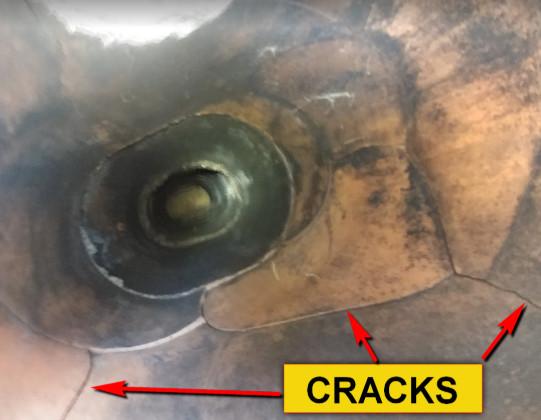
The old clay flue tile has to come out to make room for the new liner. In a properly built chimney there is a hollow air space around the tile, so we can break it into pieces with a rotary tool and take it out.
Some chimneys were built with no air space at all, with the tile surrounded directly by brick, stone or solid-filled block. In those chimneys the tile is locked in place. It will crack under the tool, but it will not come out, and a new liner cannot be installed in its place.
In that case the new liner has to be installed inside the old one, which is why it ends up smaller. When the old tile can be removed, the new liner has the whole space the old flue occupied, so it doesn't need to be any smaller than the flue it replaces.
Why your new liner may be smaller than your old flue
When the old tile can be removed, the new liner can be as large as the old flue, because there is room for it. When the tile is locked in place, or the chimney has no tile at all, the liner has to go inside what is already there and must be insulated. The insulation takes about an inch all the way around, and the liner also needs some room to move so it doesn't get stuck while it is fed down the chimney. The finished liner is therefore noticeably smaller than the flue it goes into.
A smaller flue has to suit the size of the fireplace opening for the fireplace to draft well. When the liner is small compared to the opening, we may reduce the opening with a block-off plate across the top or bottom, or extend the chimney higher.
Every house drafts a little differently, depending on its air pressure, room size, the age and tightness of its windows and doors, and how easily fresh air can get back in. For that reason the final draft can only be confirmed once the chimney is relined, and a little additional work may occasionally be needed to make it draft as it should.
Relining is not your only option
If a stainless steel liner isn't right for you, we may still be able to restore the chimney you already have. When the cracks, gaps and voids are not too severe, we can restore the existing flue with HeatShield, a coating system that seals and resurfaces the existing clay tile in place. It keeps your original chimney and your open fireplace, with no demolition.